Thursday, March 31, 2016

Defending Your Life and the Flipside


What's startling about this film is the consistent reporting that it's accurate. Michael Newton ("Journey of Souls") refers to it in my doc "Flipside" and in all the 25 cases I've filmed there are unusual reports that are either identical or oddly similar. 

"Past life Pavilion" (and its correspondent "Life Planning Session") examining your life "in front of a council of elders" where they know "everything you've ever done." 

That "hell" might be considered a difficult life here on the planet (except in this research people choose them for specific reasons), that we don't return as animals as a form of punishment (reportedly creatures have their own realms) and heaven might be considered staying back there with our soul mate, ala Meryl Streep. 

One wonders what it will be like if/when Albert experiences the same upon his departure from this stage - "oh my god, i got this SO RIGHT." 

Kudos for presaging (and writing, directing, acting in it) a film that appears to be more like a hilarious documentary of what actually happens on the Flipside. 

Again, not an issue of belief, philosophy or religion; just reporting what thousands have said (and consistently continue to do so) while under deep hypnosis, or when re-examining a near death experience (as detailed in "Its a Wonderful Afterlife" vols 1 and 2.) 

Still a funny film.


On the 25th anniversary of Defending Your Life's release, Rolling Stone asked the director to take us back to Judgment City and explore his own reasons for why the film has remained so relevant to today's audiences.

Albert Brooks: "I don't know how, where, and why the idea for Defending Your Life began; the idea had been bouncing around for a while. Stories like that sort of have to bounce. They don't come out of nowhere. I went through my own period of life with sort of everything turning upside down, and wondering, why is it this way? I went from being unafraid at the beginning of my career, in my late twenties, [to] being like the Roadrunner; I looked down and I didn't see anything. You don't wake up one day and say, "Earth ain't the best place to be." That's a brewing type of feeling.

We'd all watched "heaven" movies forever, and they always bothered me. They were just like little children's fairy tales. So I began to think more clearly that, why would anything in the universe be different than what we already see? In other words, our best indication of this vast, mysterious place are the processes that are going on right in front of us. And we see the Darwinian theories working; we see survival of the fittest working. Even in making automobiles, the better automobiles are the ones that keep getting made, so why would anything be different than that?


It intrigued me that the whole universe would be run sort of like a business. I also liked not having Earth as a place that's the best place. You don't want to go back to Earth — and by the way, they weren't threatening to send you back as an animal. It was obvious you were going to have to go back as a person and try it all over again; that was failure. So this is an alternative, but it's at least an alternative that makes some weird kind of sense to me.


"...Judgment City and the way things looked there were basically traditional matte paintings that they'd been doing since the beginning of movies. That's how they did the original Ben-Hur; just talented people painting over a city. For example, the Judgment Center, the place where we did the trials, was the Federal Building in West Los Angeles with two large annexes painted onto it, and it's just done perfectly. That never changes. You can do that today and it looks as good as it always did.

In casting the film: I met Meryl Streep at a party years and years and years ago. I think it was at Carrie Fisher's house. Meryl brought so much reputation to her life because of all these iconic roles, but when you met her, she was just so easygoing and natural. She was aware of my work, and she asked what I was doing. I told her I was making this movie, and she sort of jokingly said, "Is there a part in it for me?" I went home and thought, "Okay..." It took a lot more from the producers to make that happen, but the person that I wanted for that role was the person that I sat and talked to at that party.

So my job was to provide an environment where she could just hang out. She's the greatest character actress that ever lived, and she didn't get a lot of opportunities just to hang out, so that's what I thought could be great. She's playing somebody who's had a perfect life, and she automatically brings to that someone who is as close as you could get, someone who seemingly has had a perfect life. So all of that worked.


Rip Torn hadn't worked for a while, and the studio was a little worried because he had been through some problems and everything. We had a serious talk. The studio wanted me to go to someone safer, but Rip was one of the people that made that movie sail, and the reason is because he was unpredictable. That's why I wanted him. I saw many other actors for that part — people that I liked, people that I knew exactly what I would get — and I cast him because it may have been more work for me. But it was a good kind of work and he would give you something you didn't expect. He would just give you an attitude or a line reading or … he was just the most original kind of person, and it helped the movie immensely.


I've got a lot of favorite scenes from the movie, but I'm pretty fond of the Past Lives Pavilion. One of the things about Defending Your Life I have to mention is that the cinematographer was Allen Daviau, [who had worked a lot with Steven Spielberg]. He was brilliant. I just got a fan letter through my website two days ago — I swear to God, two days ago — that said, "I'm looking for the film that Mr. Brooks used in the Past Lives Pavilion, where the native was running through the forest. Can you tell me what film that was from?" And, of course, that wasn't from a film. All of that was shot. But the way it was shot and put into miniature? I guess I was sort of tickled that I even thought of something like the Past Lives Pavilion. I thought it was sort of a cool Disneyland ride.

And then to have Shirley MacLaine. Think about that: There is no person on this planet that can get you a laugh just by telling you about the afterlife. She had that wrapped up entirely in her personality. I met her at a hotel, I did my pitch, and I couldn't even imagine getting a "no." I must've sold it well because she did it — "Welcome to the Past Lives Pavilion." Nobody else could get you that laugh.

All of my movies had to go through the normal testing processes, and I never got E.T.-type test scores. From Real Life to Modern Romance, some of the cards were like, "What's wrong with this person?" So it was funny because this movie got like a B+ overall, but it got an A+ from young people. Literally, from 18 to 25, the cards were off the charts. I was all excited, and the studio basically said to me, "Well, we're not going to market an Albert Brooks movie to that group anyway. So it's nice, and you should feel good about it, but it doesn't matter. We're not going to release it to that group. That's a big, expensive group." And that's where the fear aspect comes in, because people at that age don't know what the hell's going on, and the movie resonated with them. It was not about life or death or Earth; I think it was about trying not to be afraid.

The idea behind Defending Your Life: Imagine if you had to sit in a courtroom and watch your life. I don't care who you are, if you committed a crime and you had to have all of your emails searched and made public, who on this planet could survive that? Nobody. Who hasn't written some angry email to somebody at 11:30 at night that, if read in court, would make you want to kill yourself?

But the interesting thing about Defending Your Life is that it's been 25 years and if you look at it on Amazon, it always sells at the same rate. And that makes me feel pretty good, because I don't think this is aging too much. I think what the movie is saying is going to stay relevant for a long, long time, because fear isn't going away.

I've had people talk about Lost in America and other films that meant something to them. But this particular movie, whatever effect it had in those original test screenings to a certain younger group, it seems to still have that. Last week, I got a letter from a parent who said their kid had memorized the whole movie. The whole movie! Now I'm not saying this is happening en masse, but sometimes, with younger people, once a movie has no electronics in it, they just don't watch it. Or even if it's not in color. They just don't relate to it. But this film does not need cell phones or any sort of modern accouterments. It still can affect you. Being afraid and not doing what you want to do is such a basic emotion.

I don't know that, any of the films that I made, I could make today. I would have to find another way to do that. It's not just me saying, "It's that the movie business." I could convince financiers that America would like me, even if they didn't, but I never could convince somebody that Korea would love Modern Romance. I just couldn't do that. [Back then] I only had one country to lie about. Now, I'd have to say, "No, believe me, China's going to go nuts over this!"

But the subjects that are the big subjects, they don't go away. Sometimes the telling of them gets modern-ed up. The thing about Defending Your Life is if you made it today, you really wouldn't make it much differently. You might not use answering machines, which played big parts in my movies, but I don't know what's in it that would be any different. I even think we were pretty clever in Rip Torn's office in that all he read were numbers. ....


... I've gotten thousands and thousands of letters of people who had relatives that were dying, or they were dying themselves, and the movie made them feel better. I guess it's because it presents some possibility that doesn't involve clouds and ghostly images. So this thing never goes away. It's a quarter of a century, but I don't think the idea behind the subject is ever going to change." Albert Brooks via Rolling Stone interview (link below)


Read more: http://www.rollingstone.com/movies/news/defending-your-life-at-25-albert-brooks-on-making-a-comedy-classic-20160322#ixzz44Vq5hzF6 

Saturday, March 19, 2016

Near Death experiences and National Geographic


David Bennett ("voyage of purpose") quoted here, tells his amazing story in my book "Its a Wonderful Afterlife Vol 1." 

What's fascinating about David's experience is he saw into the future, experienced himself surviving cancer, so when decades later, the doctor came to give him the bad news that he had weeks to live, he recognized this new doc's face from his NDE decades earlier. 

When the doc said "you won't survive this" he knew he would survive it and told him so. "You're in denial" the doc said. Turns out the doc was the one in denial. 

Good to see national geo opening up their field of vision.

From National Geographic's website:

"Coming Back From the Brink of Death"

What you see and feel in a near-death experience can profoundly change the rest of your life.

Photographic pairing showing David Bennett, who had a near-death experience

"One night off the California coast in 1983 David Bennett, chief engineer on a research vessel, and his crew tried to outrun a storm in an inflatable boat. About a mile from shore the boat was capsized by a 30-foot wave, and they were tossed into the chilly Pacific. His life vest was faulty, so his lungs filled with water. He remembers feeling total bliss. Something or someone told him it wasn’t his time, though, and after 18 minutes underwater he popped up to the surface. His crewmates, who were all floating on the water, were shocked to see him."

You can see an interview with David here, that is the source of the chapter in "It's a Wonderful Afterlife Volume One"


Photographic pairing showing Tony Cicoria, who had a near-death experience


"At a family picnic at upstate New York’s Sleepy Hollow Lake, Tony Cicoria, an orthopedic surgeon, had just tried to call his mother on the phone. An approaching storm sent a lightning bolt through the phone into his head, stopping his heart. Cicoria says he felt himself leave his body, moving through walls toward a blue-white light, eager to be one with God. He emerged from his near-death experience with a sudden passion for classical piano, creating melodies that seemed to download, unbidden, into his brain. He came to believe he’d been spared so that he could channel “the music from heaven.”

Photographic pairing showing Tricia Barker, who had a near-death experience

"A head-on collision landed Tricia Barker, then a college student, in an Austin, Texas, hospital, bleeding profusely, her spine broken. She says she felt herself separate from her body during surgery, hovering near the ceiling as she watched her monitor flatline. Moving through the hospital corridor, she says, she saw her stepfather, struggling with grief, buy a candy bar from a vending machine; it was this detail, a stress-induced indulgence he’d told no one about, that made Barker believe her movements really happened. Now a creative writing professor, she says she’s still guided by the spirits that accompanied her on the other side."

Photographic pairing with Carol Burke, who had a near-death experience

"Carol Burke was seriously injured in a car crash in the Dallas Fort Worth International Airport employee parking lot, requiring surgery to remove her spleen and repair numerous broken bones. She lost half her blood. Feeling herself floating near the ceiling of the hospital room, she could see her mother and a friend at the foot of the bed, afraid that she would not return. She remembers feeling nothing but peacefulness and love." 

Photographic pairing showing Ashlee Barnett, who had a near-death experience

"Ashlee Barnett was a college student when she had a serious car crash on a remote Texas highway. Her pelvis was shattered, her spleen had ruptured, and she was bleeding profusely. At the scene, she says, she moved between two worlds: chaos and pain on one side, as paramedics wielded the jaws of life; and one with white light, no pain, and no fear. Several years later she developed cancer, but her near-death experience made her confident that she would live. She has three children and counsels trauma survivors."

Photographic pairing showing Pam Kircher, who had a near-death experience

"Pam Kircher contracted meningitis at the age of six. She remembers being in her room in a small house outside St. Joseph, Missouri, looking down at a girl on the bed. Immediately after she recognized herself, she returned to her body. Fearing ridicule and ostracism, she kept this near-death experience secret for almost four decades, yet it motivated every life decision she made. She became a family-practice physician. Now retired, she works in hospice care and talks openly about her experience, hoping it will bring comfort to people at the end of their lives."


For more information on near death experiences, or to share one that you've experience, highly recommend checking into iands.org - where I met David Bennett.

Thursday, February 25, 2016

Visions of the Flipside


Bosch


Heres a "Tunnel of white light" as heard in a high percentage of NDEs. I've heard variations, ball of light, moving through light, towards and into light. Feelings of unconditional love, infinite wisdom and reconnecting with loved ones. 

Dr Bruce Greyson UVA created the NDE scale, appears in "Its a Wonderful Afterlife." Mario Beauregard Phd, using fmri has proven these events, memories aren't confined to any particular place in the brain, or "god spot." 

He's in the book as well. Science shows these religious experiences arent religious at all, although they do inspire people to realize life isnt confined to this realm. In my research i find no two nde's are identical, yet they all point to the same conclusion. Like the word "home" - no one can define it outside their own experience, yet we can all agree it exists within our own journey. Not based on belief or philosophy but the data. 

Bosch's depiction of hell, on the other hand, is not in the data. 

Great to see in his paintings, but the few accounts I've examined, dissolve under analysis. "So why are you experiencing this?" Or "why did you choose to be here?" allows a person to see choice or free will is involved. This tunnel, on the other hand, is the way "home" according to the 25 I've filmed and thousands of cases I've examined. 

MEANWHILE FROM THE DAILY MAIL ON FEB 25TH, 2016:


The following is a news story about a woman who died for an hour, saw her husband during an NDE and came back. I'm posting it as "further data" - and by data I mean:

I'm referring to the thousands of cases Dr Greyson has examined at UVA, the data from the Aware project (2000 cases over 10 years) even your own brothers experience during an NDE. at some point thousands of cases, examined by scientists becomes "data." And this case is no different than those. Sorry. Its just science. But you'd know that if you read Dr Greyson's chapter in "its a wonderful afterlife." Not belief. Or philosophy. Or a story in the paper. Based on thousands of medical cases.


This story is just like all the other stories. Identical. Dr. Greyson is the person who created the NDE scale back in the 80's. Indeed, the medical establishment considers NDE research science and his articles have been peer reviewed and published. He's considered the "godfather of NDE research." 

His book "Irreducible Mind" is a textbook for many psychiatrists (as he is the head psychiatrist at UVA.) Interviewed him for the book (It's a Wonderful Afterlife). There are other scientists who have studied NDE - the Aware project, where a doctor studied NDEs under clinical conditions (hospitals, ORs, etc). 

As Harvard's Gary Schwartz PhD mentions in the foreword to Flipside - "at some point you have to stop pretending" that these cases are not data. Each and every case has been examined thoroughly that Greyson cites - I recommend his youtube talk "Is consciousness produced by the brain" for further cites.

Just because a person in the UK has the identical experience that other NDE people have - that my own brother had after dying in Fort Benning Georgia - which is also reported in the book - these cases all saying relatively the same thing. And that's how Dr. Greyson was able to make a scale of events for near death experiences. 

I've stayed at Greyson's home, and he's given me a tour of his facilities at UVA. I had a conference meeting with his associates at the Dept of Perceptual Studies - including Drs Jim Tucker, Ed Kelley (PhD from Harvard) when you have thousands of people saying the same things about their experience - the same way people collect data on headaches or acne, at some point subjective reports become "evidence" and "data." 

(I refer also to Mario Beauregard's "Brain Wars" for further cites and medical cases) 

I've documented these cases on film for the past 8 years. so I'm not offering that it's data lightly - but at some point, one has to step back from the insistence that its not data to ask - "why wouldn't we consider it data? At what point or degree would you consider it data, if scientists have gone on record saying that it is data?" 

Some folks will never see these reports as anytime but conjecture (for whatever reason). That's their path. But it's not mine. I've examined thousands of these cases, documented 25 on film and dozens in print - so to me - at the end of the day, since they all say relatively the same thing "I knew it was my wife/son/daughter/best friend because I know what their touch feels like, they answered questions before I could ask them" etc... these reports become what science requires: that they be consistent and replicable.

While this woman may have invented this incident, she didnt invent dying for an hour. The report she gives of seeing her husband is consistent with many NDEs. And as I've done, taking people who've had an NDE and filming them under hypnosis allows them to replicate the event. And as noted in "Its a Wonderful Afterlife" what they report is the same event yet with more clarity. They could dispute the memory of the event, but they do not. 

Doesnt matter what religion they are, what gender or background. They consistently say the same things.

HERE'S THE ARTICLE AS REPORTED FROM THE UK:

'Sonia, it's not your time... just go back to the kids': Bingo worker who 'died' for 56 minutes says she was saved by the spirit of her late husband who told her not to die

  • Sonia Burton, 50, suffered a heart attack and had no pulse for 56 minutes
  • Paramedics refused to give up on her and continued to carry out CPR
  • Mum-of-four said her late husband visited her and said 'it's not your time'
  • Sonia thanked medics who saved her when they were reunited on Tuesday
A bingo worker who had no pulse for almost an hour after suffering a massive heart attack says her late husband visited her and said 'it's not your time'.
Sonia Burton was 'dead' for 56 minutes following her heart attack at the bingo hall in Ashington, Northumberland, but paramedics refused to give up on her.
The mum-of-four said: 'The only thing I remember is my late husband coming to me and saying "it's not your time, Sonia, go back to the children". Then I woke up in hospital.' 
Saved: Sonia, who had no pulse for almost an hour, pictured with her daughters, granddaughter and brother
Message: Sonia Burton with her late husband John. Sonia said she got a message from John, who died in 2004 following a heart attack aged just 37, while she was being resuscitated 
'Every day I think how incredible it is that I'm still here,' she said. 'I don't take anything for granted.'
On the day of her heart attack, Sonia had gone about her daily tasks with daughter Rebecca, 30.
She had been due to start work at Gala Bingo Hall in Ashington at 5.30pm but went in early at 4.45pm to talk to colleagues and have a coffee.
The 50-year-old said: 'I mainly work in the dining area and had been heading out of there when I remember getting a pain in my chest and then collapsing.'
Out cold, Sonia's frantic boss Karen Arkle began trying to resuscitate her as an ambulance was called. 
Within four minutes, paramedic Jason Riches and emergency care assistant Gary French were on the scene, taking over CPR from Karen. 
Sonia described herself as a 'living miracle' as she was reunited with the paramedics who saved her lifeSonia pictured with the people that saved her life - trainee paramedic Rosie Priest (left), and paramedics Stephen Eke (second from left) and Jason Riches (right)
Sonia pictured with the people that saved her life - trainee paramedic Rosie Priest (left), and paramedics Stephen Eke (second from left) and Jason Riches (right)
Sonia described herself as a 'living miracle' as she was reunited with the paramedics who saved her life
They were then backed up by paramedic Stephen Eke and first year student paramedic Rosie Priest.
For the next 56 minutes the team worked to save Sonia as she was transported to Northumbria Specialist Emergency Care Hospital in Cramlington.
It was while they were trying to save her that Sonia said she got a message from late husband John, who died in 2004 following a heart attack aged just 37.
'I spoke to him and he told me that it was not my time and I should go back,' she said. 'To be honest, it felt very comforting.'
By the time they arrived at Cramlington hospital, Sonia was still unconscious but had started breathing. 
She was then transferred to Newcastle's Freeman Hospital, where she underwent lifesaving surgery to have a stent fitted in her heart.
Eight days later she was back home, being cared for by brother, Mark, and her four children, Michael, 31, Megan, 22, Rebecca and 19 year old Thomas.
'It's strange to think I was technically dead for an hour,' added Sonia. 'If it wasn't for the guys being there so quickly and not giving up on me, it would have been a very different story. 
'My mind is a bit forgetful and I'm on a lot of medication but otherwise I'm doing really well - and, at the end of the day, I'm still here.'
Sonia Burton, pictured with her granddaughter Sophie Murray, said it would have been a different story if the medics had given up on her
 Sonia Burton, pictured with her family, was 'dead' for 56 minutes following her heart attack at the bingo hall
 Sonia Burton, pictured with her family, was 'dead' for 56 minutes following her heart attack at the bingo hall
Sonia's brother Mark, who she lives with, had been walking the dog when he received the call to say his sister had collapsed.
He said: 'They were working on her when I got there. It was frantic, there was no life in her at all.
'I said 'please don't stop' and, they never did.
'I couldn't be more thankful for everything Stephen, Jason and Gary did for Sonia that day. To see Sonia like she was that day and to see her now is phenomenal, I can't express just what a good job they've done.'
Paramedic Stephen, 43, said: 'Jason and I have over 50 years' experience between us and neither of us have ever seen somebody come back after that length of time.
'We often get a return of a pulse, maybe one out of 10, but usually it's just the adrenaline that's making the heart work again and as soon as that wears off they go back into cardiac arrest.
'It's unbelievable to see how well Sonia's doing now.'
Paramedic Jason, 44, said: 'You go into this job to help people. It's a nice feeling knowing that we were able to make a difference and even better to see what a remarkable recovery she's made.'


Read more: http://www.dailymail.co.uk/news/article-3418068/Bingo-worker-died-56-minutes-says-saved-late-husband-visited-said-not-time.html#ixzz41Dd8r3qL
Follow us: @MailOnline on Twitter | DailyMail on Facebook

Sunday, February 21, 2016

Quincy Jones says goodbye to Clark Terry

https://www.facebook.com/QuincyJones/videos/10153901688074631/

Don't forget to say goodbye to the ones you love and let them know it's up to them what the trip will be like. "Have a beautiful trip baby. I love you." 


Flipside published in India


This just in: 

the Indian version of my book Flipside. Beautifully published by (Prashant Solomon who is a contributing writer on spirituality for "The Times of India") 

"Thinking Tree Publishers." 

Reincarnation, between life stories filmed, transcribed by yours truly, intro'd to the country where the concept evolved. What makes these accounts different is the claim we are fully conscious between lives and we have free will to choose our next life not based on karma, but compassion. 

The desire to learn from or teach lessons to our loved ones, sometimes at their request. 

Book tour to follow in India, can't wait to return to see the Taj, stay at the Taj, while drinking a Taj Mahal.


Flipside in India!!!

Thursday, February 11, 2016

Einstein actually was an Einstein


Einstein actually was an Einstein. 

Another of his theories proven accurate, 100 years after he predicted it. Gravitational waves exist. Think of the universe as one giant pool of water; a wave from an event moves out and through the universe like ripples in a pond. But beyond that, like molecules of water, we too may be interconnected. When a wave of positivity, or a wave of negativity moves our way, we feel it, we adjust to it; we may not be conscious of it, but it's there. "There's a Nobel in this discovery" indeed. 


Einstein's theory of general relativity predicted something called gravitational waves. Science has tried to prove their...

Posted by The Guardian on Thursday, February 11, 2016
from the BBC:

Einstein's gravitational waves 'seen' from black holes


Scientists are claiming a stunning discovery in their quest to fully understand gravity.
They have observed the warping of space-time generated by the collision of two black holes more than a billion light-years from Earth.
The international team says the first detection of these gravitational waves will usher in a new era for astronomy. 

It is the culmination of decades of searching and could ultimately offer a window on the Big Bang. The research, by the Ligo Collaboration, has been published today in the journal Physical Review Letters.

The collaboration operates a number of labs around the world that fire lasers through long tunnels, trying to sense ripples in the fabric of space-time. Expected signals are extremely subtle, and disturb the machines, known as interferometers, by just fractions of the width of an atom. But the black hole merger was picked up by two widely separated LIGO facilities in the US.

"We have detected gravitational waves," David Reitze, executive director of the Ligo project, told journalists at a news conference in Washington DC. "It's the first time the Universe has spoken to us through gravitational waves. Up until now, we've been deaf."


Prof Karsten Danzmann, from the Max Planck Institute for Gravitational Physics and Leibniz University in Hannover, Germany, is a European leader on the collaboration.He said the detection was one of the most important developments in science since the discovery of the Higgs particle, and on a par with the determination of the structure of DNA.

"There is a Nobel Prize in it - there is no doubt," he told the BBC.
"It is the first ever direct detection of gravitational waves; it's the first ever direct detection of black holes and it is a confirmation of General Relativity because the property of these black holes agrees exactly with what Einstein predicted almost exactly 100 years ago."

Ripples in the fabric of space-time


  • Gravitational waves are prediction of the Theory of General Relativity
  • Their existence has been inferred by science but only now directly detected
  • They are ripples in the fabric of space and time produced by violent events
  • Accelerating masses will produce waves that propagate at the speed of light
  • Detectable sources ought to include merging black holes and neutron stars
  • LIGO fires lasers into long, L-shaped tunnels; the waves disturb the light
  • Detecting the waves opens up the Universe to completely new investigations

That view was reinforced by Professor Stephen Hawking, who is an expert on black holes. Speaking exclusively to BBC News he said he believed that the detection marked a moment in scientific history.

"Gravitational waves provide a completely new way at looking at the Universe. The ability to detect them has the potential to revolutionise astronomy. This discovery is the first detection of a black hole binary system and the first observation of black holes merging," he said.

"Apart from testing (Albert Einstein's theory of) General Relativity, we could hope to see black holes through the history of the Universe. We may even see relics of the very early Universe during the Big Bang at some of the most extreme energies possible."Team member Prof Gabriela González, Louisiana State University said: "We have discovered gravitational waves from the merger of black holes. It's been a very long road, but this is just the beginning.

"Now that we have the detectors to see these systems, now that we know binary black holes are out there, we'll begin listening to the Universe. "

The Ligo laser interferometers in Hanford, in Washington, and Livingstone, in Louisiana, were only recently refurbished and had just come back online when they sensed the signal from the collision. 

Prof Stephen Hawking: "This provides a completely new way of looking at the universe."
Prof Sheila Rowan, who is one of the lead UK researchers involved in the project, said that the first detection of gravitational waves was just the start of a "terrifically exciting" journey.

"The fact that we are sitting here on Earth feeling the actual fabric of the Universe stretch and compress slightly due to the merger of black holes that occurred just over a billion years ago - I think that's phenomenal. It's amazing that when we first turned on our detectors, the Universe was ready and waiting to say 'hello'," the Glasgow University scientist told the BBC.

Being able to detect gravitational waves enables astronomers finally to probe what they call "dark Universe" - the majority part of the cosmos that is invisible to the light telescopes in use today.

Perfect probe

Not only will they be able to investigate black holes and strange objects known as neutron stars (giant suns that have collapsed to the size of cities), they should also be able to "look" much deeper into the Universe - and thus farther back in time. It may even be possible eventually to sense the moment of the Big Bang.

"Gravitational waves go through everything. They are hardly affected by what they pass through, and that means that they are perfect messengers," said Prof Bernard Schutz, from Cardiff University, UK.

"The information carried on the gravitational wave is exactly the same as when the system sent it out; and that is unusual in astronomy. We can't see light from whole regions of our own galaxy because of the dust that is in the way, and we can't see the early part of the Big Bang because the Universe was opaque to light earlier than a certain time.

"With gravitational waves, we do expect eventually to see the Big Bang itself," he told the BBC.

In addition, the study of gravitational waves may ultimately help scientists in their quest to solve some of the biggest problems in physics, such as the unification of forces, linking quantum theory with gravity.

At the moment, the General Relativity describes the cosmos on the largest scales tremendously well, but it is to quantum ideas that we resort when talking about the smallest interactions. Being able to study places in the Universe where gravity is extreme, such as at black holes, may open a path to new, more complete thinking on these issues.


  • A laser is fed into the machine and its beam is split along two paths
  • The separate paths bounce back and forth between damped mirrors
  • Eventually, the two light parts are recombined and sent to a detector
  • Gravitational waves passing through the lab should disturb the set-up
  • Theory holds they should very subtly stretch and squeeze its space
  • This ought to show itself as a change in the lengths of the light arms (green)
  • The photodetector captures this signal in the recombined beam

Scientists have sought experimental evidence for gravitational waves for more than 40 years. 

Einstein himself actually thought a detection might be beyond the reach of technology. 

His theory of General Relativity suggests that objects such as stars and planets can warp space around them - in the same way that a billiard ball creates a dip when placed on a thin, stretched, rubber sheet. 

Gravity is a consequence of that distortion - objects will be attracted to the warped space in the same way that a pea will fall in to the dip created by the billiard ball.

Inspirational moment

Einstein predicted that if the gravity in an area was changed suddenly - by an exploding star, say - waves of gravitational energy would ripple across the Universe at light-speed, stretching and squeezing space as they travelled. 

Although a fantastically small effect, modern technology has now risen to the challenge.

Much of the R&D work for the Washington and Louisiana machines was done at Europe's smaller GEO600 interferometer in Hannover.

"I think it's phenomenal to be able to build an instrument capable of measuring [gravitational waves]," said Prof Rowan. 

"It is hugely exciting for a whole generation of young people coming along, because these kinds of observations and this real pushing back of the frontiers is really what inspires a lot of young people to get into science and engineering."


Off the port bow.


WHY IT MATTERS.

The Universe is not composed how we thought it was:Finite objects moving through space.

It actually is more like a pool.

And gravity - is the relation between objects in that pool.  

BUT MORE IMPORTANTLY:

We are all molecules in the pool.  So what happens on one side of the pool effects the other side of the pool.  We are energy. The pool is composed of energy. So if one side of the pool has a bad attitude, it affects our side of the pool.

But we can combat that bad attitude with our own tool of choice: consciousness.  We can affect the rest of the pool by focusing our energy into something that's the opposite of the bad attitude.

Do you see where I'm going with this?

If Tonglen - the Tibetan meditation studied by Richard Davidson at the University of Wisconsin is an actual cure or can alleviate the symptoms of depression - THAT MEANS that by mental imagining, we can CHANGE OUR CONSCIOUSNESS.

Let me say that again.

By using a meditation - and Tonglen is the one that was studied, we can alter the physical structure of our brain - specifically the amgydala, which Davidson's study showed "even one session" of meditation could change the shape of this small part of the brain that retains depression.

So if mental processes can change the shape of the amygdala - then mental processes can affect other areas of the body.

Like a wave.

And by extension - even though THERE'S NO EVIDENCE that mental processes - meditation, etc change those things on the outside of the body, it follows that like a ripple, or like a wave, it eventually will change the energy outside of the brain.

So - meditating on the good health of someone else (a Tonglen concept) helps us... and there's a possibility that it MIGHT help someone else.

The universe is a big pool of energy.

Which is exactly what I saw when I had my own "out of body" experience.  I don't call it a near death experience because I was lying in my bed - I had an awful cold, so I don't think I died, but here is what happened to my consciousness. (It's not unlike what people experience in near death observations, but was years prior to my Flipside research)

As I was drifting off to sleep I felt myself DISSOLVE.

I was conscious of myself dissolving into a SEA OF ATOMS.  I can only call it that, because I was aware of myself turning into a shimmering blob of light - and it was golden.  And it was like a thousand fireflies in my mind, and a tingling sensation of utter joy and connectedness.  Overwhelming that I was going to faint from the joy.

But I consciously thought "I need to expore this! What is this?"  So my conscious mind still existed within this framework to allow me to want to explore.  And I willed myself to continue to be "awake" as it took effort not to pass out.  I saw this eddy of golden light move and dissipate - and then as if looking from one end of a pool, I saw that there was this giant vast sea of energy all around me.  

And then as if looking out into the vast pool of light, I saw this small cloud of dark or gray light coming towards me - and instantly understood that to be a small blot of negativity - coming my way.  I was aware that this was how "negative thoughts" - directed at me, or directed somehow towards me find their way into your consciousness.

But as I saw the gray light coming towards me, instead of fear, (which was my first option, as in "oh no, what's this?") I chose to think a positive thought... and it was right out of a special effects moment - I thought "I can defeat that negativity with a burst of positive thought" - and all the atoms of water in this vast pool around me suddenly began to glow, and rushed out like a giant colored pool of ink - a golden light that engulfed and dissipated the dark light - as far as the eye could see.

The next thing I observed is that I was "outside of time."  I observed that I was looking back at the earth from a perspective outside of it - and saw it as a circular time frame.  So that if I put my finger in one side of the globe, it might be in the 8th century, and if I put my finger on the other side, it might be yesterday - and so therefore I could be simultaneously in both places at once.  Because I was outside of time.

Then I observed that wherever there was a photograph of myself - of Richard - no matter what age, no matter where on the planet, I could easily move to that object.  As if the photo itself had captured my essence, or time - like a piece of a hologram contains all the elements of the larger picture - and I found myself visiting an attic of a relative where a box of photos existed with myself in them, and then into someone's wallet where there existed a photo of us in our youth, etc...

So wherever a photograph existed of myself it was like a portal - I could more easily access it because it contained a reference point for me to access.

If this vision is accurate, then I would recommend whenever you want to speak to a loved one who is not longer on the planet, to take out a photograph of them and address it in present tense.  Ask a question, or make a comment and see if perhaps they are able to respond. Either with the first thought that comes into your mind, or by some event that happens during the day, or coming week that reminds you of something about that person.

It's their way of responding.

And finally, ask them a question you don't know the answer to.  (I always ask for lottery numbers, and I almost always get a laugh). But some detail in your life that only this person would know - and will prove that they not only still exist, but are aware of what you're wrestling with.

A long way of saying, "Thanks Albert!"

 What's funny is that it relates to this video that I happened to catch the other day. (two black holes traveling through the universe, that collide)

 https://www.youtube.com/watch?v=pnbJEg9r1o8

Friday, January 29, 2016

Fractals and the Happiest Man on Earth


Scientists find evidence of mathematical structures in classic books


Researchers at Poland’s Institute of Nuclear Physics found complex ‘fractal’ patterning of sentences in literature, particularly in James Joyce’s Finnegans Wake, which resemble ‘ideal’ maths seen in nature
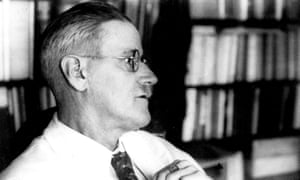
 James Joyce in Paris in 1937.
James Joyce
 James Joyce’s Finnegans Wake has been described as many things, from a masterpiece to unreadable nonsense. But it is also, according to scientists at the Institute of Nuclear Physics in Poland, almost indistinguishable in its structure from a purely mathematical multifractal.

The academics put more than 100 works of world literature, by authors from Charles Dickens to Shakespeare, Alexandre Dumas, Thomas Mann, Umberto Eco and Samuel Beckett, through a detailed statistical analysis. Looking at sentence lengths and how they varied, they found that in an “overwhelming majority” of the studied texts, the correlations in variations of sentence length were governed by the dynamics of a cascade – meaning that their construction is a fractal: a mathematical object in which each fragment, when expanded, has a structure resembling the whole.


“All of the examined works showed self-similarity in terms of organisation of the lengths of sentences. Some were more expressive – here The Ambassadors by Henry James stood out – others to far less of an extreme, as in the case of the French 17th-century romance Artamene ou le Grand Cyrus. However, correlations were evident, and therefore these texts were the construction of a fractal,” said Dr PaweÅ‚ OÅ›wiÄ™cimka from the Institute of Nuclear Physics of the Polish Academy of Sciences, one of the authors of the new paper Quantifying Origin and Character of Long-range Correlations in Narrative Texts.
Some works, however, were more mathematically complex than others, with stream-of-consciousness narratives the most complex, comparable to multifractals, or fractals of fractals. Finnegans Wake, the scientists found, was the most complex of all.

“The absolute record in terms of multifractality turned out to be Finnegans Wake by James Joyce. The results of our analysis of this text are virtually indistinguishable from ideal, purely mathematical multifractals,” said Professor StanisÅ‚aw Drożdż, another author of the paper, which has just been published in the computer science journal Information Sciences.

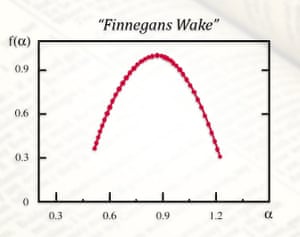
Multifractal analysis of Finnegan’s Wake by James Joyce. The ideal shape of the graph is virtually indistinguishable from the results for purely mathematical multifractals. The horizontal axis represents the degree of singularity, and the vertical axis shows the spectrum of singularity.
Photo: IFJ Pan
Multifractal analysis of Finnegan’s Wake by James Joyce: the graph shape is virtually indistinguishable from the results for purely mathematical multifractals. The horizontal axis represents the degree of singularity, while the vertical axis shows the spectrum of singularity. Photograph: IFJ PAN
Joyce himself, reported to have said he wrote Finnegans Wake “to keep the critics busy for 300 years”, might have predicted this. In a letter about the novel, Work in Progess as he then knew it, he told Harriet Weaver: “I am really one of the greatest engineers, if not the greatest, in the world besides being a musicmaker, philosophist and heaps of other things. All the engines I know are wrong. Simplicity. I am making an engine with only one wheel. No spokes of course. The wheel is a perfect square. You see what I’m driving at, don’t you? I am awfully solemn about it, mind you, so you must not think it is a silly story about the mouse and the grapes. No, it’s a wheel, I tell the world. And it’s all square.”
The academics write in their paper that: “Studying characteristics of the sentence-length variability in a large corpus of world famous literary texts shows that an appealing and aesthetic optimum … involves self-similar, cascade-like alternations of various lengths of sentences.”
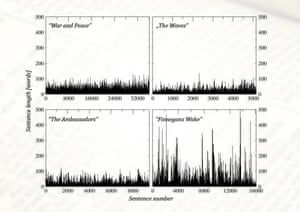
Sequences of sentence lengths (as measured by number of words) in four literary works representative of various degrees of cascading character.
Sequences of sentence lengths (as measured by number of words) in four books, representative of various degrees of cascading character. Photograph: IFJ PAN
“An overwhelming majority of the studied texts simply obey such fractal attributes but especially spectacular in this respect are hypertext-like, ‘stream-of-consciousness’ novels. In addition, they appear to develop structures characteristic of irreducibly interwoven sets of fractals called multifractals.”
The other works most comparable to multifractals, the academics found, were A Heartbreaking Work of Staggering Genius by Dave Eggers, Hopscotch by Julio Cortazar, The USA trilogy by John Dos Passos, The Waves by Virginia Woolf, 2666 by Roberto Bolaño and Joyce’s Ulysses. Marcel Proust’s À la recherche du temps perdu showed “little correlation” to multifractality, however; nor did Ayn Rand’s Atlas Shrugged.

The academics note that “fractality of a literary text will in practice never be as perfect as in the world of mathematics”, because a mathematical fractal can be magnified to infinite, while the number of sentences in a book are finite.

“It is not entirely clear whether stream-of-consciousness writing actually reveals the deeper qualities of our consciousness, or rather the imagination of the writers. It is hardly surprising that ascribing a work to a particular genre is, for whatever reason, sometimes subjective,” said Drożdż, suggesting that the scientists’ work “may someday help in a more objective assignment of books to one genre or another”.

Drożdż suggested today that the findings could also be used to posit that writers “uncovered fractals and even multifractals in nature long before scientists”. “Evidently, they (like Joyce) had a kind of intuition, as it happens to great artists, that such a narrative mode best reflects ‘how nature works’ and they properly encoded this into their texts,” he said. “Nature evolves through cascades and thus arranges fractally, and imprints of this we find in the sentence-length variability.”

Eimear McBride, whose multiple award-winning debut novel A Girl is a Half-Formed Thing is written in a stream-of-consciousness style, said she wasn’t taken aback by the results.

“It doesn’t surprise me that works described as “stream of consciousness” appear to be the most fractal. By its nature, such writing is concerned not only with the usual load-bearing aspects of language – content, meaning, aesthetics, etc – but engages with language as the object in itself, using the re-forming of its rules to give the reader a more prismatic understanding of the subject at hand. Given the long-established connection between beauty and symmetry, finding works of literature fractally quantifiable seems perfectly reasonable.”

But she added that she couldn’t “help being somewhat disappointed by the idea that the main upshot of this research may be to make the assigning of genre more straightforward”.

“Surely there are more interesting questions about the how and why of writers’ brains arriving at these complex, but seemingly instinctive, fractals?” she said. “And, given Professor Drożdż’s pretty inarguable contention that it remains unclear whether or not stream-of-consciousness writing does indeed reveal a deeper layer of consciousness, what distance this research may go to explain why some readers believe themselves to be experiencing exactly that while others have the opposite reaction?”


So what does this have to do with the Flipside you ask?

A bit hard to digest. But scientists have put the "number of words in a sentence" to measure recurring length in great works of art, and discovered that many are fractals - a mathematical structure that has within it, a repeated sequence. 

In this dense article, they argue that somehow great artists tap into "unconscious" fractals - and call Joyce's "Finnegan's Wake" the ultimate in "Stream of consciousness writing." 

Here's the thing. In my "Flipside" and "It's a Wonderful Afterlife" research, people talk about seeing "fractals" while under deep hypnosis, and when asked to describe the contents of these "geometric shapes" that appear to follow people around, one claimed they were like "external hard drives that contain all the memories of our previous lifetimes." 

Another claimed they contain "ancient information." And now here is the Guardian quoting Polish scientists saying that fractals are not only inherent in nature (snowflakes) but also in art. As if we have the code of fractal creation somewhere in our consciousness, we may not be aware of it, but it appears in our art. 

 Next up would be to examine other works of art to see if this pattern repeats itself. "What's the point?" you might ask? It's that consciousness isn't confined to the brain. And if that's true, then everything we think we know about the planet is off, wrong. A fundamental rethink is in order. Don't shoot the messenger. A fractal is defined as: a curve or geometric figure, each part of which has the same statistical character as the whole. Fractals are useful in modeling structures (such as eroded coastlines or snowflakes) in which similar patterns recur at progressively smaller scales, and in describing partly random or chaotic phenomena such as crystal growth, fluid turbulence, and galaxy formation."

Turns out that we too are working within the fractal universe, but just aren't aware of it.

Until now.

Here's an interesting headline, that I've been mentioning in all of my books:

A 69-year-old monk who scientists call the 'world's happiest man' says the secret to being happy takes just 15 minutes a day

Follow Business Insider:
Matthieu Ricard
Matthieu Ricard
Matthieu Ricard, the world's happiest man.
Who is the happiest man in the world? If you Google it, the name "Matthieu Ricard" pops up.

Matthieu Ricard, 69, is a Tibetan Buddhist monk originally from France who has been called "the world's happiest man."
That's because he participated in a 12-year brain study on meditation and compassion led by a neuroscientist from the University of Wisconsin, Richard Davidson.

Davidson hooked up Ricard's head to 256 sensors and found that when Ricard was meditating on compassion his mind was unusually light.

Simple Capacity details the findings:
The scans showed that when meditating on compassion, Ricard’s brain produces a level of gamma waves – those linked to consciousness, attention, learning and memory – ‘never reported before in the neuroscience literature’, Davidson said. The scans also showed excessive activity in his brain’s left prefrontal cortex compared to its right counterpart, allowing him an abnormally large capacity for happiness and a reduced propensity towards negativity.

Ricard, who says he sometimes meditates for entire days without getting bored, admits he's a generally happy person (although he feels his "happiest man" title is a media-driven overstatement).
He spoke with Business Insider at the World Economic Forum in Davos, Switzerland. Here's his advice for how to be happy.

Stop thinking 'me, me, me'

To Ricard, the answer comes down to altruism. The reason is that, thinking about yourself and how to make things better for yourself all the time is exhausting and stressful, and it ultimately leads to unhappiness.

"It's not the moral ground," Ricard says. "It's simply that me, me, me all day long is very stuffy. And it's quite miserable, because you instrumentalize the whole world as a threat, or as a potential sort of interest [to yourself]."

If you want to be happy, Ricard says you should strive to be "benevolent," which will not only make you feel better but also make others like you more.

That's not to say you should let other people take advantage of you, Ricard warns, but you should generally strive to be kind within reason.

"If your mind is filled with benevolence, you know, the passion and solidarity ... this is a very healthy state of mind that is conducive to flourishing," Ricard says. "So you, yourself, are in a much better mental state. Your body will be healthier, so it has been shown. And also, people will perceive it as something nice."

That all sounds great in theory, but how does a person actually become altruistic and benevolent and not let selfish thoughts creep in?

Start training your mind like you'd train to run a marathon

Ricard believes everyone has the ability to have a lighter mind because there's a potential for goodness in every human being (unless you're, say, a serial killer, and there's something actually chemically abnormal going on with your brain).

But like a marathon runner who needs to train before he or she can run 26.2 miles, people who want to be happier need to train their minds. Ricard's preferred way of training his is meditation:

"With mental training, we can always bring [our level of happiness] to a different level. It's like running. If I train, I might run a marathon. I might not become an Olympic champion, but there is a huge difference between training and not training. So why should that not apply to the mind? ... There is a view that benevolence, attention, emotional balance and resilience are skills that can be trained. So if you put them all together, you could say that happiness is a skill that can be trained.

OK, so how does one train their mind to be happier?

Just spend 15 continuous minutes a day thinking happy thoughts

Start by thinking happy thoughts for 10 to 15 minutes a day, Ricard says. Typically when we experience feelings of happiness and love, it's fleeting and then something else happens, and we move on to the next thought. Instead, concentrate on not letting your mind get distracted, and keep focused on the positive emotions for the next stretch of time.

And if you do that training every day, even just two weeks later you can feel positive mental results. And if you practice that for 50 years like Ricard has, you can become a happiness pro too. That's backed up by neuroscientists, by the way. Davidson found in his study that even 20 minutes of daily meditation can make people much happier overall.
_______________________________________
 
I asked Richard Davidson what specific meditation he used in the epic Univ of Wisconsin study. 


"Tonglen" he told me. "But a non specific version." Meaning instead of the traditional Tibetan Buddhist meditation (paraphrasing) where you imagine a person who is ill and then you "call upon the healing light of the universe" to draw the illness (anger, sickness, rage) from them into you, and as it comes into you, you transform it into healing energy and breathe that energy back into them - instead of visualizing a person, the monks visualized the planet as a sick patient. 

So focusing on losing the word "me" "mine" and "I" is one way of eliminating self focus, but the other way is to actually think of people you love (or don't love, depending) who are in need of a cure, and you visualize yourself helping to facilitate that cure. The point is simple; Science proves that by doing so you can "cure or eliminate symptoms of depression" in yourself. 

There's no evidence that the meditation cures or helps the other person, (or prayer for that matter, but it can't hurt) but there is science that absolutely proves that it can cure depression. Literally "loving your neighbor as yourself" affects the amygdala, the part of the brain where depression resides. 

Davidson says that even "one session of meditation" (or tonglen) can change the physical shape of the amygdala. Should be included/required in every doctor's kit bag; every school yard; ten minutes a day cures or alleviates symptoms of depression (and eventually replaces medications involved with amygdala suppression (SSRI drugs like zoloft and prozac) which as we know, in some people, some children, have dangerous side effects (suicide/violent acts). 

 Let me say it again. Ten minutes a day. Cure (or alleviate symptoms of) depression. Not a fad. Not a religion. Not a philosophy. It's free. It's science. It's data with proven results. 

("Is this mic on?")


A sunset from a year ago....

An old sunset from a year ago. 

Does a foto capture a slice of time the way a piece of a hologram carries all the info of the object? 

If so, everything in a foto still exists, just have to figure out a way to access it, or tune ourselves to it. Virtual reality may be useful, using the senses to recreate an experience, or retain info from a place or person. 

If they still exist, then creating an environment they could access would be key to hearing, seeing them. That is, a field where those outside of time could revisit old information... or loved ones. 

My two cents.

Journey Into Tibet

I spent a few weeks with Robert Thurman in Tibet, documenting his journey there. There are clips avail on youtube, but here is the complete documentary "Journey Into Tibet."

GoodReads